You know that feeling when you're hiking on a steep, rocky trail, and you have to look down to carefully place every single footstep? One wrong move and you're tumbling. Now, imagine doing that at full speed, leaping several times your own body length between jagged boulders. Sounds impossible, right? Well, not if you're a klipspringer. These little African antelopes are the parkour masters of the mountains, and a huge part of their superpower comes from their eyes. I mean, we call them "klipspringer eyes," but honestly, that's like calling a Ferrari's engine "a car part." It completely undersells the engineering marvel we're talking about.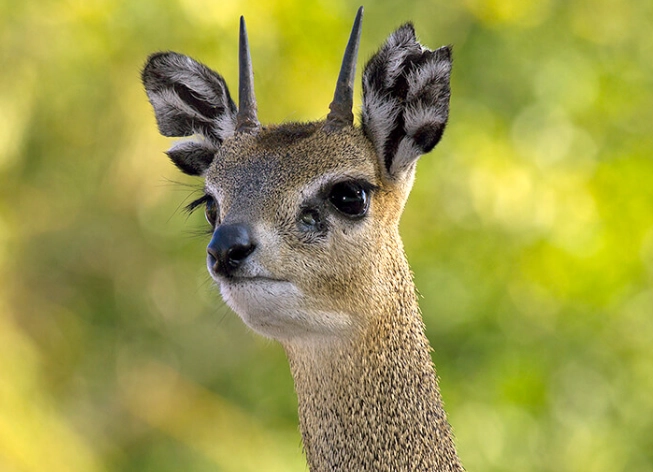
I remember the first time I saw a klipspringer in real life, in the Drakensberg mountains. It was just a tiny speck, a silhouette against the sky, perched impossibly on the edge of a sheer rock face. It turned its head, and even from a distance, you could sense this intense, focused gaze. It wasn't just looking; it was mapping. That moment sparked a years-long fascination for me. What is it about klipspringer eyes that lets them live a life of vertical danger with such apparent ease? Let's break it down, without the textbook jargon.
The Anatomy of a Klipspringer's Eye: Built for the Precipice
If you were to design an eye for an animal that lives on cliffs, you'd probably come up with something pretty close to what the klipspringer has. It's not just one feature, but a whole suite of adaptations that work together.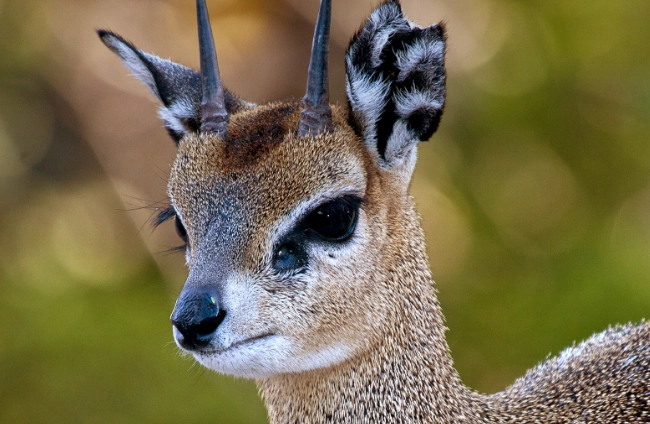
Pupil Shape: The Horizontal Advantage
This is the most noticeable feature. Unlike our round pupils or the vertical slits of a cat, klipspringers have pronounced horizontal, rectangular pupils. Think of a grazing goat or a horse—same idea. Why horizontal? It's all about the panoramic view. This shape dramatically widens their field of view along the horizontal plane. For an animal that needs to scan a vast, rocky landscape for predators (like leopards or eagles) while also judging complex, three-dimensional terrain, this is a game-changer. It gives them a near-360-degree awareness without having to constantly move their head, which is crucial when balance is everything. Some research, like that published in the Journal of Experimental Biology, suggests horizontal pupils help keep the horizon in sharp focus, which aids in stabilizing their vision as they move.
Eye Placement and Depth Perception
Their eyes are positioned prominently on the sides of their head. This again boosts that wide field of view but comes with a trade-off: it reduces binocular vision (where both eyes focus on the same object). You'd think that would be bad for judging distances before a leap. But here's the clever part. Klipspringers have a specialized area in their retina (the part at the back of the eye that senses light) and they likely use motion parallax. That's a fancy term for judging distance by how much objects seem to move relative to each other as they turn their head. It's a different, but highly effective, system for a creature that needs to gauge the gap between rock A and rock B with life-or-death accuracy. It's less about a single, static snapshot of depth and more about a dynamic, processed understanding of the 3D world as they move.
Other Key Features in the Toolkit
- Visual Acuity: Their ability to resolve fine detail is thought to be excellent. They need to spot a camouflaged predator hiding among rocks from a significant distance.
- Color Vision: As diurnal (day-active) animals, they likely have good color vision, which helps in distinguishing between rocks, lichen, and potential food sources like shrubs and herbs.
- Protection: Living in dusty, windy environments, their eyes are well-protected. They have a third eyelid (a nictitating membrane) that can sweep across to clean and moisten the eye without blocking vision completely.
Put all this together, and you have an optical system that is less about seeing a beautiful sunset and more about processing a high-stakes, real-time terrain map. It's functional brilliance.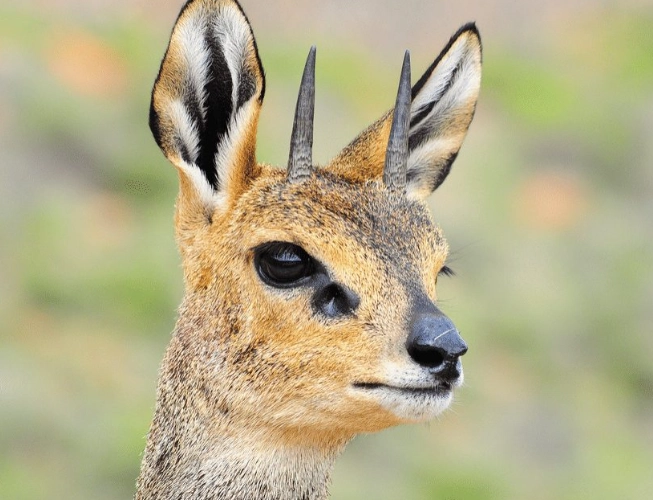
How Klipspringer Eyes Stack Up: A Quick Comparison
| Feature | Klipspringer | Human | Domestic Cat | Reason for Difference |
|---|---|---|---|---|
| Pupil Shape | Horizontal rectangle | Round | Vertical slit | Maximizes horizontal field of view for scanning terrain and predators. |
| Eye Placement | Wide-set on sides of head | Front-facing | Front-facing | Sacrifices some binocular vision for a huge panoramic view. |
| Primary Visual Need | Terrain mapping & predator detection in open, complex landscapes. | Detail, color, and social cue recognition. | Low-light hunting and judging pouncing distance. | Dictated by lifestyle and ecological niche. |
How Klipspringer Vision Dictates Their Entire Lifestyle
You can't talk about klipspringer eyes in isolation. Their vision is the core processor that drives every aspect of their behavior. It's the ultimate example of form meeting function.
Feeding with Awareness: They are browsers, eating leaves, flowers, and fruits from shrubs. While their head is down feeding, those horizontally-aligned, side-placed eyes are still scanning almost the entire surrounding landscape. A predator would have a very hard time sneaking up.
The Art of the Leap: This is where it all comes together. Before a jump, you'll often see a klipspringer make subtle head bobs. They're not being nervous; they're actively using motion parallax to calculate the distance, the stability of the landing spot, and the angle of ascent or descent. Their brain is processing a flood of visual data about texture, shadow, and relative movement to make a split-second go/no-go decision. It's a high-speed calculus problem we do consciously with great effort, but for them, it's instinctual, powered by their specialized eyes.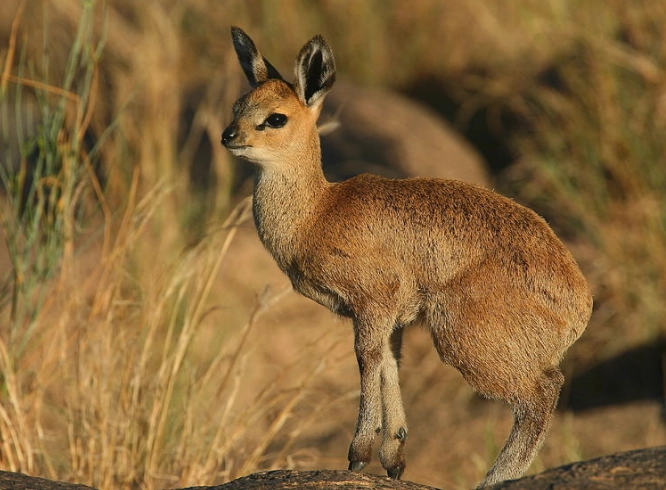
Social Structure and Vision: Klipspringers often live in monogamous pairs or small family groups. This social structure is reinforced by their vision. In an open, rocky habitat, keeping visual contact is easier than in a dense forest. Their excellent long-distance vision allows a pair to keep track of each other across a rocky slope, communicating with sharp whistles if danger is spotted by one pair of those incredible klipspringer eyes.
Evolutionary Why: The Story in the Rocks
So how did they end up with these eyes? Evolution doesn't have a plan, but it has relentless pressure. The ancestors of modern klipspringers were likely more generalist antelopes. As some populations began to exploit rocky, mountainous habitats to escape competition and predators on the plains, the rules of survival changed.
Individuals born with slightly wider-set eyes, or pupils that were a bit more oblong, had a slight advantage. They could spot predators a fraction of a second sooner or misjudge a jump a little less often. Over thousands of generations, these slight advantages were compounded. The habitat selected for these traits, sculpting the modern klipspringer's entire physiology—from their hooves to their center of gravity to, most importantly for our discussion, their eyes. It's a perfect case study in adaptive radiation, where a species evolves specific traits to fit a very specific ecological niche. The Journal of Mammalogy often features studies on such morphological adaptations in mammals, highlighting how environment shapes form.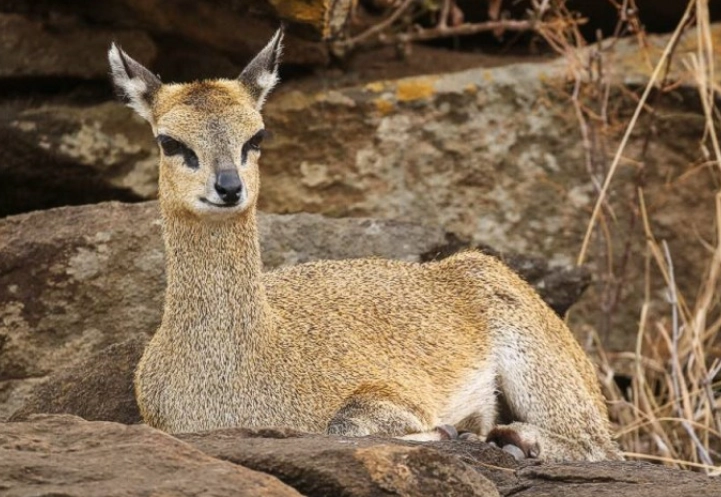
A Personal Gripe: You'll sometimes see klipspringers described as having "goat-like" eyes. While it's a useful shorthand, it bugs me a little. It makes it sound like a copy. In reality, it's a spectacular example of convergent evolution—where unrelated animals (goats and klipspringers) face similar challenges (life on steep, open terrain) and evolve similar solutions (horizontal pupils). It's not copying; it's nature independently arriving at the same brilliant answer.
Common Questions About Klipspringer Eyes (The Stuff You Actually Want to Know)
Let's get into some specifics. These are the questions I had, and the ones I see pop up again and again.
Can klipspringers see in the dark?
They are primarily day-active, so their night vision isn't as supercharged as a leopard's. However, their large eyes (relative to their head size) do let in a good amount of light. You might find them active at dawn, dusk, or on bright moonlit nights. But they're not truly nocturnal. Their vision is optimized for the complex light and shadow of rocky landscapes during the day, not pitch darkness.
How far can a klipspringer see?
It's hard to give a number in meters, but their visual acuity for detecting movement and shape is exceptional at long range. In their habitat, sight lines can be long. Being able to spot a distant eagle or a lion climbing the lower slopes is a key survival skill. Their vision is tuned for this—filtering out the static clutter of rocks and focusing on the anomalous movement that signals danger.
Are they colorblind?
Almost certainly not. Most diurnal mammals have at least dichromatic color vision (two types of color receptors). This is hugely beneficial for telling the difference between dry, brown grass and green, nutritious leaves, or between a grey rock and a tawny-colored predator. Color adds a crucial layer of information to their high-definition terrain map.
What's the biggest threat to their vision?
Injury is an obvious one—a scratch from a thorn or a rock chip could be devastating. But in the modern world, habitat fragmentation is a subtler threat. Being forced into smaller, isolated rocky patches might increase encounters with domestic animals and the diseases they carry. While not common, certain pathogens could theoretically affect eye health. Their biggest threat remains habitat loss and, historically, hunting.
Observing Klipspringers: Tips for the Wildlife Enthusiast
If you're ever on safari in rocky areas like the Matobo Hills in Zimbabwe, the Simien Mountains in Ethiopia, or parts of South Africa's Cape, keep your eyes peeled. But don't look for movement—look for shape. Klipspringers have an incredible habit of freezing when they first sense danger. They become a rock. Look for the silhouette that's just a little too straight, a little too symmetrical. Often, you'll spot the male first, standing sentinel on the highest point. Use binoculars, and if you're lucky, you'll see those distinctive horizontal pupils. Watch how they move their heads—it's never a frantic swivel, but a slow, deliberate scan. You're witnessing a masterclass in evolved perception.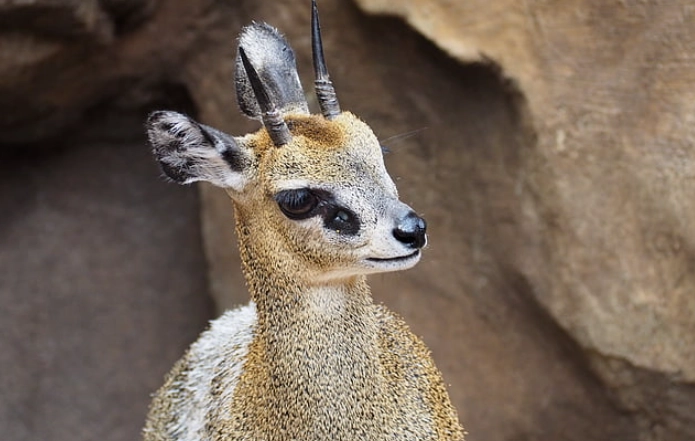
Their conservation status is currently listed as "Least Concern" by the IUCN Red List, but that doesn't mean they're everywhere. They are highly dependent on their specific rocky habitat, which protects them but also makes them vulnerable if that habitat is degraded or destroyed.
The Bottom Line on Klipspringer Eyes
To call klipspringer eyes just "good eyesight" is a massive understatement. They are a integrated sensory system, fine-tuned by millions of years of evolutionary pressure. The horizontal pupil, the side placement, the acute detail detection—it's all in service of one thing: surviving in a world of vertical drops and hidden threats. They don't just see their environment; they visually understand it in a way we can barely comprehend. It's a reminder that every animal perceives a different world, a unique umwelt, built by the senses evolution gave them. For the klipspringer, that world is a detailed, panoramic, three-dimensional map where every rock, shadow, and movement tells a story. And it's all processed through one of nature's most remarkable optical instruments.
Next time you see a picture of a klipspringer perched precariously on a cliff, you'll know. It's not clinging on in fear. With those eyes, it's standing confidently in the center of its universe, seeing everything it needs to see to not just survive, but thrive.
Comment