Okay, let's talk about something that's equal parts fascinating and slightly terrifying. Fish with sharp teeth. You see them in movies, you hear stories from fishermen, and if you've ever been snorkeling, maybe the thought has crossed your mind. What's the deal with all those pointy grins lurking beneath the surface? Are they all waiting to take a chunk out of the nearest swimmer? The answer is a lot more interesting, and thankfully, less dramatic than Hollywood makes it out to be.
I remember the first time I saw a barracuda up close. It was off a reef in the Caribbean, just hanging in the current. The sun caught its silvery side, and for a second, all I could see was that lower jaw packed with uneven, razor-like teeth. My heart skipped a beat. But it just looked at me, turned, and vanished. It wasn't interested. That moment got me hooked on understanding why fish evolve these dental arsenals in the first place. It's not just about being scary. It's about survival, diet, and some truly incredible evolutionary engineering.
The Core Idea: Sharp teeth in fish aren't a monolith. They come in wildly different shapes and for wildly different purposes. From the serrated blades of a shark designed for slicing through seal blubber to the needle-like pins of a piranha meant for shearing off scales and flesh quickly, form follows function in the most brutal and beautiful ways.
Why Do Fish Even Need Sharp Teeth?
It seems like a simple question, but the answers are layered. Think about it. Growing and maintaining a set of complex teeth takes energy. In the efficient world of nature, if an animal has them, they serve a critical purpose. For fish with sharp teeth, that purpose almost always ties directly to what's on the menu.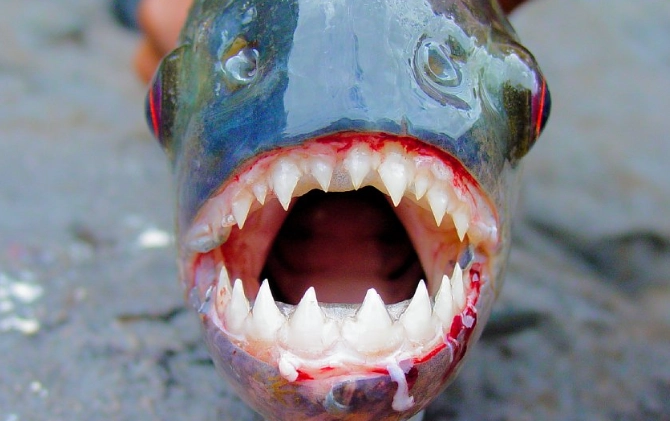
The Primary Drivers: Diet and Feeding Strategy
You are what you eat, and more importantly, you bite what you eat. The design of a fish's teeth is a direct blueprint of its feeding habits.
Predators: This is the group everyone thinks of. Fish that actively hunt other live prey. Their sharp teeth are tools for capture, holding, and processing. A great white shark's triangular, serrated teeth are perfect for gripping slippery, muscular prey like seals and inflicting massive hemorrhage. They're not for chewing—sharks swallow large chunks. A barracuda's fangs are designed for a quick, slashing attack to disable smaller fish. The shape minimizes drag and maximizes cutting efficiency.
Piscivores (Fish-eaters): A subset of predators, these guys specialize in other fish. Their teeth are often numerous, needle-sharp, and angled backwards. Why? To prevent a struggling, slippery meal from wriggling free. Once those teeth sink in, there's no going back. Think of a pike or a large bass.
Omnivores and Specialists: Here's where it gets cool. Not all fish with sharp teeth are pure carnivores. The sheepshead fish, for example, has human-like incisors and molars in the back. It uses them to crush crabs, barnacles, and mollusks. Their teeth aren't for tearing flesh but for applying immense crushing force to hard shells. Parrotfish have beak-like teeth fused together to scrape algae off coral, and some even have pharyngeal teeth in their throats to grind the coral into sand (they're the reason for much of the white sand on tropical beaches!).
A Quick Aside on Regeneration: This is one of the most mind-blowing adaptations. Many fish with sharp teeth, especially sharks and piranhas, have teeth that are constantly replaced throughout their lives. They're arranged in rows, and as a front tooth wears down or is lost, a new one from the row behind moves forward to take its place. It's like a conveyor belt of weaponry. The Smithsonian's National Museum of Natural History has some great resources on how shark dentition works, showing just how efficient this system is. You can lose a tooth during a hunt? No problem, there's another one ready to go.
Meet the Cast: A Rundown of Notable Fish with Sharp Teeth
Let's put names and faces to those dental nightmares (and wonders). This isn't an exhaustive list, but it covers the usual suspects and some surprising entries.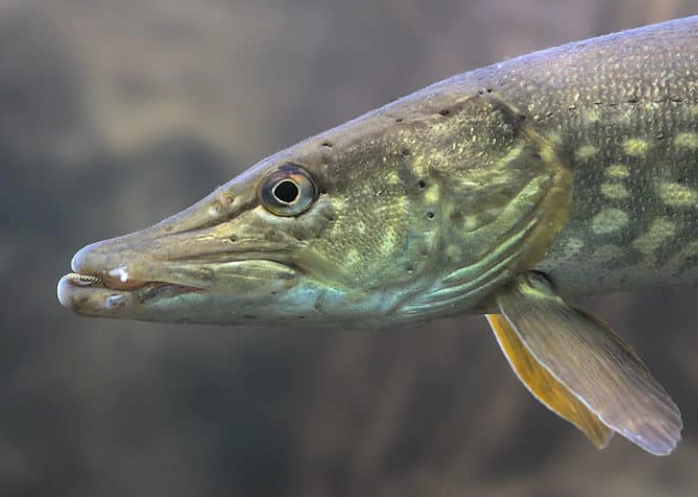
I've always found it helpful to compare them side-by-side. It really highlights how different their strategies are.
| Fish Species | Tooth Type & Description | Primary Diet | Habitat | Risk to Humans |
|---|---|---|---|---|
| Great White Shark | Large, triangular, serrated blades. Arranged in multiple rows. | Marine mammals (seals, sea lions), large fish, carrion. | Cool coastal waters worldwide. | Very low statistically, but potentially severe. Investigated bites are often cases of mistaken identity. |
| Piranha (e.g., Red-Bellied) | Razor-sharp, triangular, interlocking teeth. Single row. Incredibly strong bite force for size. | Fish, insects, crustaceans, seeds, occasionally larger animals (usually dead/dying). | Freshwater rivers & lakes in South America. | Generally low. Feeding frenzies on humans are largely myth. Nips can occur during dry season or if provoked. |
| Barracuda (Great Barracuda) | Prominent, uneven fangs. Lower jaw juts out. Designed for slashing. | Fish, squid. | Tropical & subtropical oceans, often near reefs. | Very low. Rare, usually involve mistaken identity (shiny objects). Meat can be toxic (ciguatera). |
| Payara (Vampire Fish) | Two massive, protruding lower fangs that fit into sockets in the upper jaw. Up to 6 inches long! | Almost exclusively other fish. Impales them. | Freshwater in Amazon Basin (Orinoco River). | Virtually none. Deep river dweller, no interest in humans. |
| Muskellunge (Muskie) | Numerous long, needle-sharp teeth on jaws and roof of mouth. All angled backwards. | Fish, ducks, small mammals. | North American freshwater lakes & rivers. | |
| Moray Eel | Long, sharp, often curved teeth. Some species have pharyngeal jaws (a second set that launches forward to pull prey in!). | Fish, crustaceans, cephalopods. | Rocky crevices & coral reefs in tropical/temperate seas. | Low, but can be defensive. Most bites occur when harassed by divers or if a hand is mistaken for food in a crevice. |
| Bluefish | Razor-sharp, triangular cutting teeth. Known for frenzied feeding, often leaving prey fish shredded. | Schooling fish like menhaden, anchovies. | Coastal temperate & subtropical waters worldwide. | Low, but anglers need extreme caution when unhooking them—they will bite aggressively. |
Looking at that table, the variety is staggering, isn't it? From the iconic great white to the almost alien-looking payara, each set of chompers is a masterclass in adaptation. It's also crucial to note the "Risk to Humans" column. This is where perception and reality wildly diverge.
Danger, Myths, and Reality: Should You Be Worried?
This is the million-dollar question for most people searching about fish with sharp teeth. The short answer is: be informed and respectful, not fearful.
The media loves a good monster story. Movies like "Piranha 3D" or sensational shark attack headlines have warped our understanding. The reality is far less cinematic but much more important for your safety.
The Real Risk Factors: The vast majority of negative encounters with fish with sharp teeth are not predatory attacks on humans. They fall into three main categories: 1. Defensive bites (you stepped on a stingray, harassed a moray eel, or cornered a fish), 2. Investigative/ Mistaken identity bites (a shark bumping a surfer, a barracuda going for a shiny watch), and 3. Fisherman handling injuries (this is probably the most common—trying to unhook a toothy fish like a bluefish, pike, or even a large catfish carelessly).
Let's talk about piranhas for a second, since they're the poster children for "fish with sharp teeth" hysteria. Are they capable of inflicting a nasty bite? Absolutely. Their teeth are like scalpels, and their bite force is legendary for their size. But the idea of a school stripping a cow or a human to the bone in minutes is fantasy. Dr. Hélder Queiroz from the Instituto Nacional de Pesquisas da Amazônia has conducted extensive research showing piranhas are primarily scavengers and opportunistic feeders. Most aggressive behavior is observed during the dry season when they are crowded in shrinking pools and starving. Healthy humans swimming in their habitat are almost never attacked. The National Geographic fact page on piranhas does a great job separating the Hollywood myth from the fascinating biological reality.
Sharks? The statistics are clear. You are exponentially more likely to be injured by a toilet, a ladder, or a coconut than by a shark. The International Shark Attack File (ISAF) maintained by the Florida Museum provides rigorous, data-driven analysis of global shark-human interactions. Their work consistently shows that even in "attack" cases, a single bite is often followed by the shark releasing and leaving—suggesting it was an investigatory or mistaken identity event, not a predation attempt on a human.
So, what's the practical takeaway? Respect the environment. Don't swim in murky water where predators hunt (especially at dawn/dusk). Don't wear shiny jewelry in barracuda territory. Don't spearfish and then dangle bleeding fish on your belt. And for heaven's sake, if you're fishing and catch a fish with sharp teeth, learn the proper handling technique or use a tool. I've seen more nasty gashes from people trying to grab a hooked pike than from any other source.
Evolution in Action: How Teeth Shape Survival
Zooming out, the story of sharp teeth is the story of evolution fine-tuning a tool over millions of years. It's an arms race between predator and prey. As prey fish evolved faster speeds, better camouflage, or tougher scales, predators evolved teeth better suited to catch and process them.
Consider the difference between a shark's serrated tooth and a piranha's interlocking triangle. The shark tooth is a slicing tool for large, thick-skinned prey. The serrations act like a steak knife, sawing through tough connective tissue. The piranha tooth is a shearing and puncturing tool for smaller, softer-bodied prey. The interlocking design creates a continuous cutting edge when the jaw closes, allowing it to snip off a neat piece of flesh with incredible efficiency.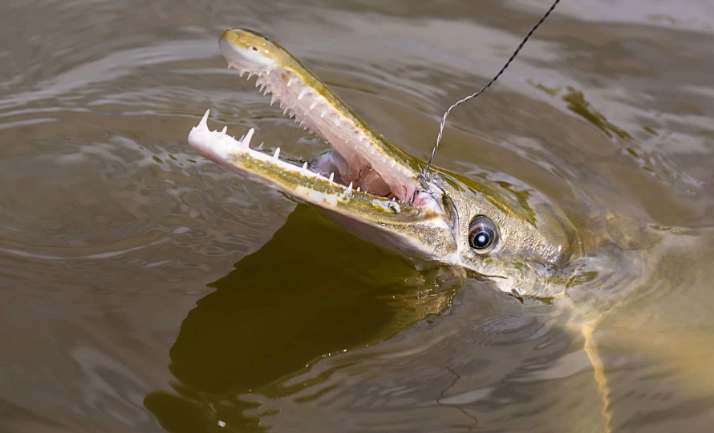
Then you have the specialists. The cookiecutter shark has a bizarre lower jaw full of large, triangular teeth, but its upper teeth are tiny. It uses its sucking lips and unique dentition to latch onto much larger animals (like tuna, dolphins, and even submarines!) and twist out a perfect, cookie-shaped plug of flesh. It's a parasitic lifestyle enabled by a one-of-a-kind dental arrangement.
The U.S. National Oceanic and Atmospheric Administration (NOAA) Fisheries service has fascinating research on how fish morphology, including dentition, is linked to ecosystem roles and can even be affected by environmental changes. Studying these teeth helps scientists understand food webs and the health of aquatic ecosystems.
Handling and Safety: A Practical Guide for Anglers and Divers
This is the hands-on stuff. If you're going to be around these animals, a little knowledge goes a long way toward a safe and positive experience.
For Anglers:
- Tools are your friend: Always carry long-nose pliers, hemostats, or a dehooker. Your fingers do not belong near the mouth of a fish with sharp teeth.
- Control the head: Learn how to properly grip certain species. For a pike or muskie, gripping firmly behind the head and over the gill cover (carefully, to avoid gill rakers) is a common method. Never put your fingers in its mouth.
- Use a landing net: A good rubber-mesh net can subdue a thrashing fish, keeping its teeth away from you and reducing injury to the fish.
- Lip grips? For some species, these can work, but be cautious. On a very large, heavy fish with sharp teeth, the weight swinging from its jaw can cause tissue damage. Know the limitations.
For Swimmers and Divers:
- Avoid sensory triggers: Don't wear shiny, reflective jewelry or watches. To a barracuda, it looks like a flashing baitfish.
- Stay out of the food chain: Avoid swimming where people are actively fishing or cleaning fish. Don't swim in murky water, especially near river mouths where predatory fish might hunt.
- Be aware of activity peaks: Many predators are most active at dawn, dusk, and night.
- Don't harass wildlife: This should be obvious. Don't try to feed, touch, or chase any marine life, especially a fish with sharp teeth. A defensive bite is still a bite.
- If you see a shark: Stay calm. Maintain eye contact if possible. Back away slowly. Don't turn your back and don't splash frantically. Most of the time, it's just curious and will leave.
Common Questions About Fish with Sharp Teeth
Let's tackle some of the specific questions people are probably typing into Google.
Q: What is the fish with the sharpest teeth?
This is tricky because "sharpest" can mean different things. In terms of cutting ability relative to size, piranha teeth are famously sharp and efficient. In terms of individual tooth size relative to body, the payara's (vampire fish) 6-inch fangs are hard to beat. For sheer number and regenerative ability, sharks win.
Q: Can a fish with sharp teeth bite through fishing line?
Absolutely. Species like bluefish, mackerel, and barracuda are notorious for this. That's why anglers targeting them use wire leaders or very heavy fluorocarbon leaders. Their teeth can slice through standard monofilament like butter.
Q: Why do some fish have teeth that look human?
The sheepshead fish is the classic example. Its "human" teeth (incisors and molars) are adapted for its diet of hard-shelled invertebrates. The incisors pry barnacles off pilings, and the molars in the back crush crabs and mollusks. It's a perfect example of convergent evolution—developing similar structures for similar ecological jobs, even though we're not closely related at all.
Q: Do fish with sharp teeth lose their teeth?
Constantly! As mentioned, sharks, piranhas, and many others have polyphyodont dentition—they replace teeth throughout their life. A single shark may go through tens of thousands of teeth in its lifetime. That's why shark teeth are common fossils; they were shed in vast numbers.
Q: Are freshwater or saltwater fish with sharp teeth more dangerous?
It's not about salinity; it's about species and context. A great white shark (saltwater) has the potential for a more severe injury than a piranha (freshwater). However, you're statistically more likely to have a negative encounter with a smaller, more common toothy fish while handling it incorrectly (e.g., a northern pike in freshwater or a bluefish in saltwater). Risk is about behavior, not just the animal's capability.
Final Thoughts: Appreciation Over Fear
After all this, my perspective has shifted from that initial heart-pounding moment with the barracuda. Fish with sharp teeth aren't monsters. They're marvels. Each mouth tells a story of an evolutionary path, a specific ecological niche, and a survival strategy refined over eons.
They remind us that the underwater world operates on different rules, with different tools. Our job isn't to fear them, but to understand them. To respect their space and their adaptations. Whether you're an angler, a diver, or just someone curious about nature, I hope the next time you see a picture of those sharp teeth, you see less of a threat and more of a fascinating biological solution to the eternal problem of getting dinner.
The ocean and rivers aren't our domain. We're visitors. And when we visit, understanding the locals—even the ones with the intimidating smiles—makes the trip a whole lot richer and safer.
Want to Learn More Reliably? Stick to reputable scientific and conservation sources. The Florida Museum of Natural History (home of the International Shark Attack File), NOAA Fisheries, and institutions like the Smithsonian or National Geographic Society provide information grounded in research, not sensationalism. It's the best way to fuel your curiosity without the fear-mongering.
Comment