Let's talk about one of the ocean's most elegant weirdos—the snipe eel. If you've never heard of it, you're not alone. This creature spends its life in perpetual darkness, between 300 and 2000 meters down, in a part of the ocean we know less about than the surface of Mars. It's not a monster, but its anatomy is a masterclass in evolutionary problem-solving. Forget everything you think you know about eels. This one hunts with a biological tool that still baffles scientists with its simplicity and efficiency.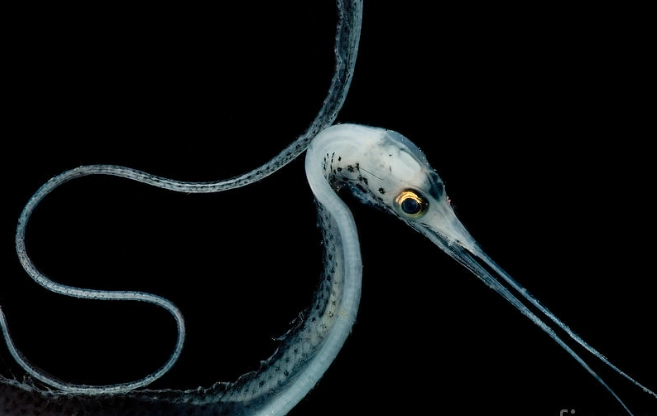
Dive Into This Guide
What Exactly Is a Snipe Eel?
The snipe eel (*Nemichthys scolopaceus*) is a thin, ribbon-like fish that can grow over a meter long but often weighs less than a few ounces. Its body is so slender it looks like it's been stretched. The most striking feature is its beak. The jaws curve away from each other and are lined with tiny, hook-like teeth. They never fully close. This isn't a design flaw—it's the entire point of its existence.
I remember the first time I saw one on a research monitor during a deep-sea ROV dive. It looked impossibly fragile, drifting vertically in the blackness. Everyone on comms went quiet for a second. It's one of those animals that makes you realize how much we still have to learn.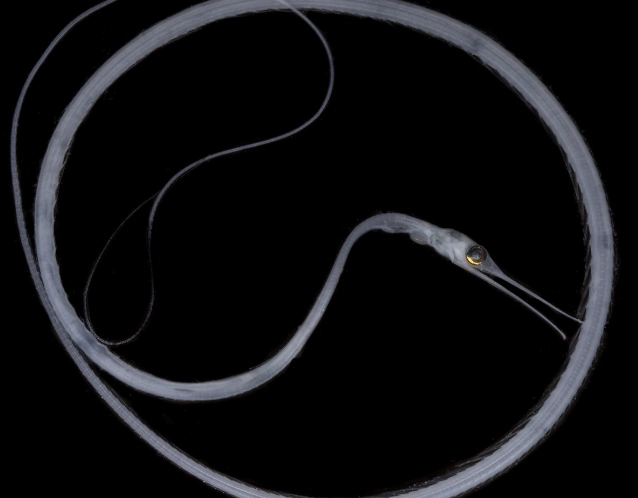
Where Do Snipe Eels Live? (The Real Map)
You won't find a snipe eel at your local coral reef. Its world is the mesopelagic and bathypelagic zones—the twilight and midnight zones of the open ocean. They are pelagic, meaning they live in the water column, not on the bottom.
They have a global distribution, but they're not everywhere equally. Your best bet for an encounter is in the temperate and tropical waters of the Atlantic, Pacific, and Indian Oceans. They perform daily vertical migrations, following their prey upwards at night. This is a critical detail often missed. If you're on a research vessel, the nets you deploy at 500 meters at midnight will have a much higher chance of catching one than the same nets deployed at noon.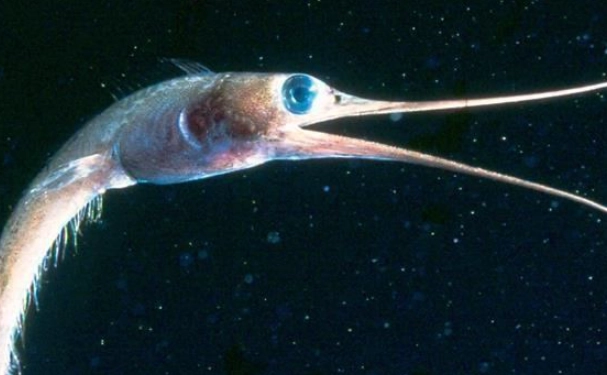
Prime "Snipe Eel Spotting" Conditions
- Location: Open ocean, far from continental shelves.
- Depth: Most common between 400-800 meters at night; 1000+ meters during the day.
- Water Temperature: Cold, typically between 4°C to 10°C (39°F to 50°F).
- Equipment Needed: A deep-sea trawl net, a Remotely Operated Vehicle (ROV), or a manned submersible. Sorry, snorkeling gear won't cut it.
How a Snipe Eel Hunts: The Jaw Trick
This is where it gets brilliant. The snipe eel's primary diet is deep-sea crustaceans, like shrimp and krill. These prey have long antennae and legs. The eel's hunting strategy is passive and energy-efficient.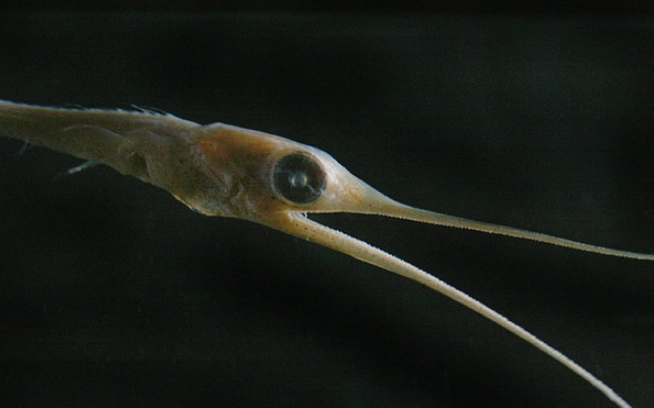
It swims slowly with its beak slightly agape. When a shrimp brushes against the inside of those curved jaws, the tiny, backward-facing teeth act like a Velcro trap. The shrimp is snagged. The eel then simply closes its jaws further—the curved tips act like scissors, snipping the antenna or limb off. It doesn't swallow the whole shrimp immediately; it can "reel in" the captured morsel. This method allows it to feed on large, agile prey without a costly chase in an environment where calories are scarce.
Most diagrams get this wrong. They show the jaws snapping shut like a mouse trap. That's too active. The real action is in the initial, almost casual, entanglement. It's a filter-feeding strategy adapted for larger, mobile prey.
How to Spot a Snipe Eel (If You're Lucky)
For scientists and avid followers of deep-sea exploration feeds, here's what to look for. On ROV footage, they often appear as faint, vertical lines. They can be stationary or drifting. Their movement is languid, not frantic. Because they are so thin, they are often missed unless the camera lights catch them just right.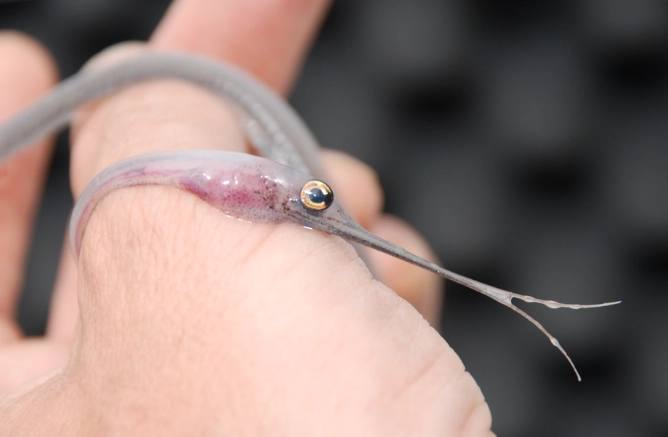
If you're analyzing deep-sea trawl catches (a messy but common way to study them), handle them with extreme care. Their bodies are gelatinous and tear easily. A common mistake is to assume a broken specimen is a different species—it's probably just a damaged snipe eel. Preserve them in buffered formalin quickly, as they decompose faster than most fish.
Snipe Eel vs. Pelican Eel: Stop the Confusion
This is the biggest mix-up online. Both are deep-sea eels with weird heads, but they are from different families and hunt in opposite ways. Confusing them is like calling a cheetah a leopard.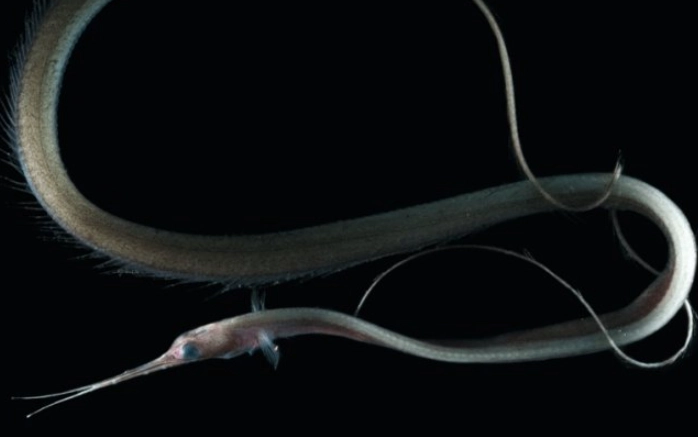
| Feature | Snipe Eel (*Nemichthyidae*) | Pelican Eel / Gulper Eel (*Eurypharyngidae*) |
|---|---|---|
| Jaws & Head | Long, slender, needle-like jaws that curve apart. Tiny teeth. | Massive, loosely-hinged lower jaw. Huge, pouch-like mouth. Tiny teeth. |
| Hunting Method | Passive "trap-and-snip." Catches limbs of crustaceans. | Active "gulp." Swims into large swarms of prey and engulfs them whole. |
| Body Shape | Extremely slender, ribbon-like for its entire length. | Thin tail, but the body expands into a large, pelican-like throat pouch. |
| Tail | Ends in a long, thin filament. | Has a light-producing organ (photophore) on the tail tip. |
| Key Analogy | A pair of delicate, curved forceps. | A living fishing net with a built-in headlamp. |
The pelican eel gets all the dramatic press because of its giant mouth. But the snipe eel's precision tool is, in my opinion, a more fascinating adaptation. It solves a specific problem with minimal energy expenditure—the ultimate deep-sea hack.

Comments
Leave a Comment