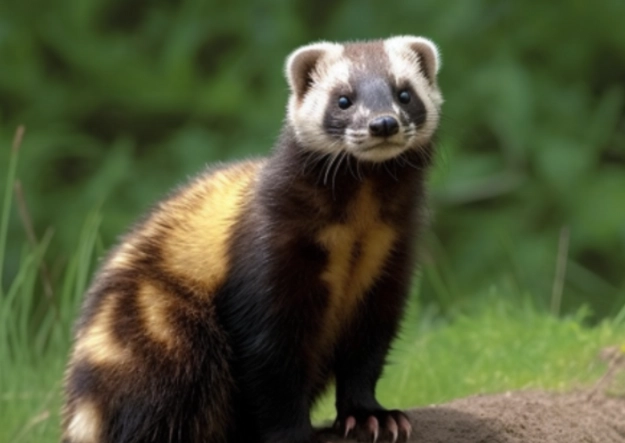
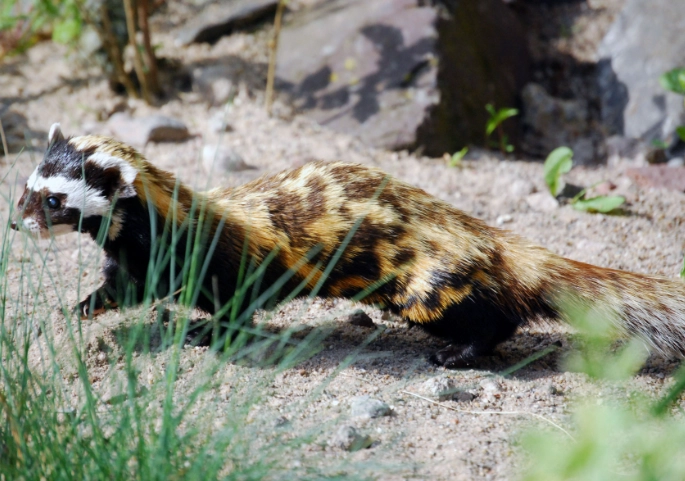
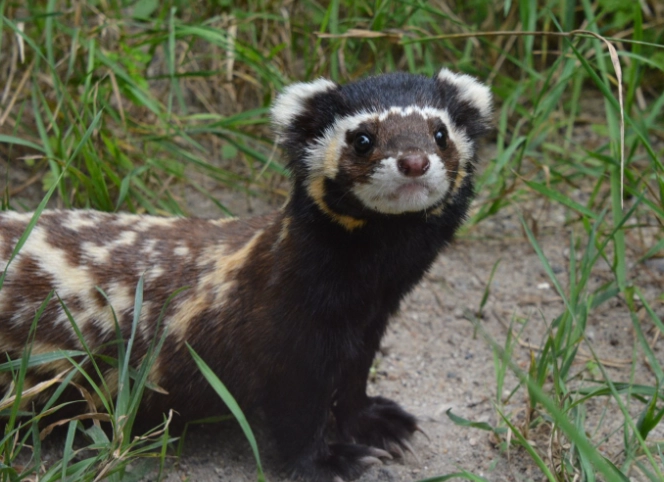
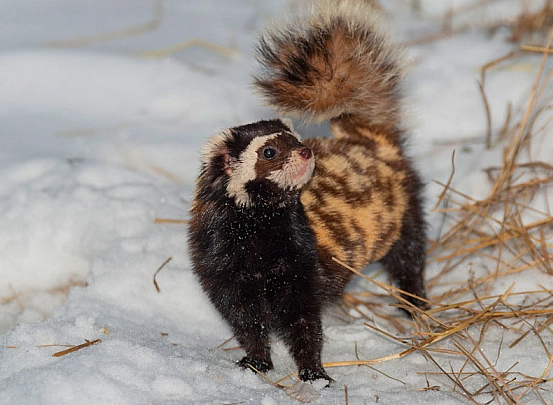
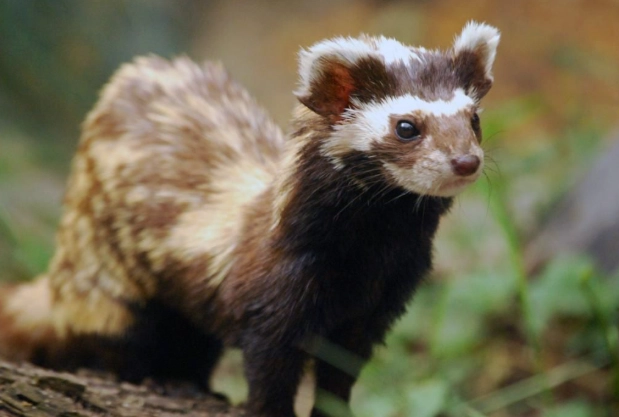
Let's cut to the chase. The marbled polecat (Vormela peregusna) isn't your typical charismatic mammal. You won't find it on many conservation posters next to pandas or tigers. It's small, secretive, and has a face that looks perpetually surprised. But spend five minutes learning about its bizarre behaviors and precarious existence, and you'll be hooked. This isn't just another animal fact sheet. This is a deep dive into the life of a creature that embodies the quiet drama of the Eurasian steppes, and why its survival matters more than you might think. First, identification. If you're scanning the grasslands, look for a weasel-like animal, about the size of a ferret (30-40 cm body, plus a 15-20 cm bushy tail). The marbling—those beautiful black and white swirls and spots on a rich yellowish-brown background—is unmistakable. That bold facial mask of black and white isn't for fashion; it's a warning sign. Combined with a shock of bright yellow fur on its head and a tail that flares when threatened, it's nature's way of saying "back off." Here's a detail most summaries miss: their dental formula. They have fewer molars than other polecats, a specific adaptation linked to their diet. It's a tiny detail, but it speaks to a unique evolutionary path. Everyone knows mustelids have scent glands. The marbled polecat takes it to an art form. When threatened, it doesn't just release a smell. It arches its back, flares its tail to show the white underside, and releases a secretion so potent it can be smelled by humans from several meters away. I've spoken to researchers who've had their clothes smell for days after a close encounter. It's not just a deterrent; it's a chemical billboard advertising danger. Their hunting strategy is pure efficiency. They're primarily fossorial, meaning they love digging. A huge portion of their diet is ground squirrels, gerbils, and hamsters. They don't just chase them; they excavate them. I once watched footage from a camera trap in Kazakhstan where a polecat spent twenty minutes meticulously digging out a souslik burrow. The patience was incredible. They'll also eat birds, reptiles, and insects, but rodents are the main event. A Common Mistake: Many sources label them as strictly nocturnal. That's an oversimplification. In my experience reviewing field data, their activity is highly crepuscular (dawn and dusk) and can shift to diurnal (daytime) in cooler seasons or in areas with less human disturbance. Calling them purely nocturnal might cause observers to miss prime viewing windows. Their social life is solitary, except for mating season. Females give birth to small litters (4-8 kits) in deep, complex burrows they often take over from their prey. The kits develop quickly, but mortality is high in that first year. Forget dense forests. The marbled polecat is a creature of open spaces. Its range is a vast but fragmented belt across southeastern Europe (parts of Greece, Bulgaria, Romania), through the Middle East, and into Central Asia as far as China and Mongolia. Prime Habitats: If you're serious about trying to see one, your best bet is joining a dedicated mammal-watching tour in countries like Kazakhstan, Uzbekistan, or Mongolia. In Europe, the population in Hungary's Hortobágy National Park is one of the most studied and potentially observable western populations, though seeing one is never guaranteed. It's pure luck mixed with endless patience. This is where it gets grim. The International Union for Conservation of Nature (IUCN) lists the marbled polecat as Vulnerable. Their population is declining almost everywhere. The causes aren't flashy—they're slow, systemic, and devastating. Habitat Loss is King: The conversion of steppe and grassland to intensive agriculture is the number one threat. Monoculture fields offer no cover, no prey, and are often poisoned with rodenticides. Secondary Poisoning: This is a massive, under-reported killer. Farmers put out poison for "pest" rodents. The polecats eat the poisoned rodents and die. It's a silent, cascading effect that decimates local populations. Declining Prey Base: Widespread rodent control programs directly reduce their food source. Road Mortality and Persecution: They get hit by cars and are sometimes killed by people who mistakenly see them as poultry threats. The fragmentation is the real killer. Populations become isolated, genetic diversity drops, and a single bad event can wipe out a local group for good. Conservation efforts are patchy. Some countries have legal protection, but enforcement in remote areas is weak. There are a few dedicated research and conservation programs, like those run by the IUCN Small Carnivore Specialist Group, but funding is minimal compared to more "glamorous" species. Feeling helpless? Don't. Concrete actions exist beyond just "raising awareness." The biggest impact comes from shifting the narrative. Talk about the marbled polecat as an indicator species. Healthy polecat populations mean healthy, rodent-balanced grasslands. That's a story about ecosystem function, not just saving a cute animal. So there you have it. The marbled polecat isn't just a weird-looking weasel. It's a resilient specialist hanging on in a world that's rapidly smoothing out the rough, wild edges it depends on. Its survival is a test of whether we value functioning ecosystems over uniform, sterile efficiency. The next time you think of wilderness, think beyond the forests and oceans. Think of the whispering grasses of the steppe, and the small, marbled shadow moving silently through them.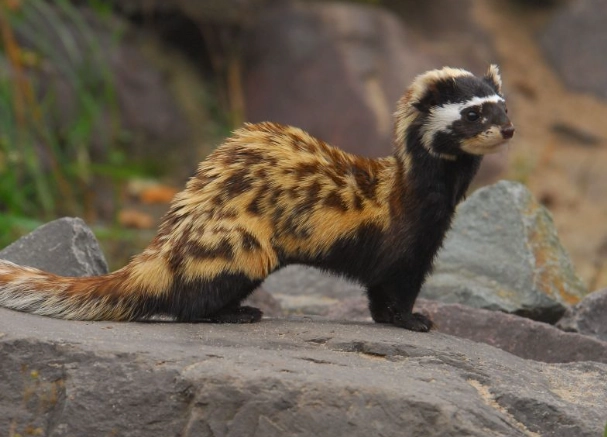
What's Inside?
Spotting the Unique: Key Traits of the Marbled Polecat
Behavior Beyond the Basics: More Than Just a Stink
Habitat and Where to Look (If You're Lucky)
The Silent Conservation Crisis
How You Can Actually Help
Your Marbled Polecat Questions Answered
I'm hiking in potential marbled polecat habitat in Hungary. How do I maximize my chance of seeing one without disturbing it?
Dawn and dusk are your best bets. Move slowly and quietly, scanning the edges of grasslands and along dirt embankments. Use binoculars to check distant burrow entrances for movement. Never try to lure one, block a burrow, or use playback calls—this causes immense stress. The goal is passive observation. Your presence should be undetectable. If you're lucky enough to see one, keep your distance, enjoy the moment, and take a mental picture. A blurry photo from a mile away isn't worth spooking it.
Are marbled polecats kept as pets, and is it a good idea?
You might see videos online. It's a terrible idea. They are wild animals with complex needs—digging, a highly specific diet, potent scent marking, and solitary nature. Captive breeding for the pet trade is virtually non-existent, meaning any animal offered likely came from the wild, further harming populations. They do not domesticate. You'd end up with a stressed, destructive animal and a house that smells like a chemical weapon. Admire them in the wild where they belong.
What's the single biggest misconception about their conservation status?
The idea that because they have a wide range, they must be okay. That's the "range map fallacy." Their range is a Swiss cheese of fragmented, declining populations. A wide distribution on paper can mask a catastrophic decline in actual numbers and genetic health. The threat isn't one big event, but a thousand small cuts: a poisoned field here, a plowed pasture there. It's death by a thousand agricultural decisions.
How does their "Vulnerable" status compare to more well-known mustelids like the European mink?
The European mink is Critically Endangered, facing imminent extinction, often due to direct competition with the invasive American mink. The marbled polecat's situation is different—more insidious. No invasive species is outcompeting it. The habitat itself, the very fabric of the steppe, is being erased and poisoned. Saving it requires landscape-scale changes in land use, which is politically and economically complex. In some ways, that makes the fight harder, even if the extinction clock isn't ticking *quite* as loudly.
Comment