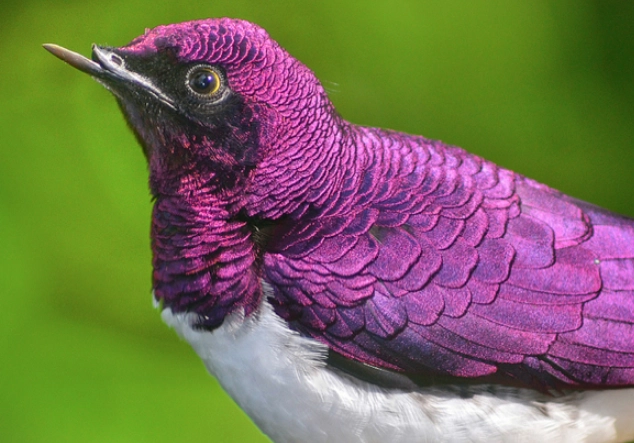
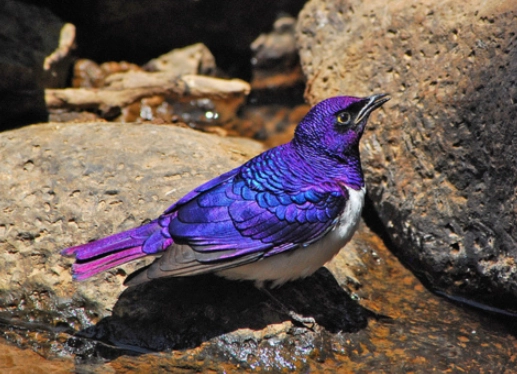
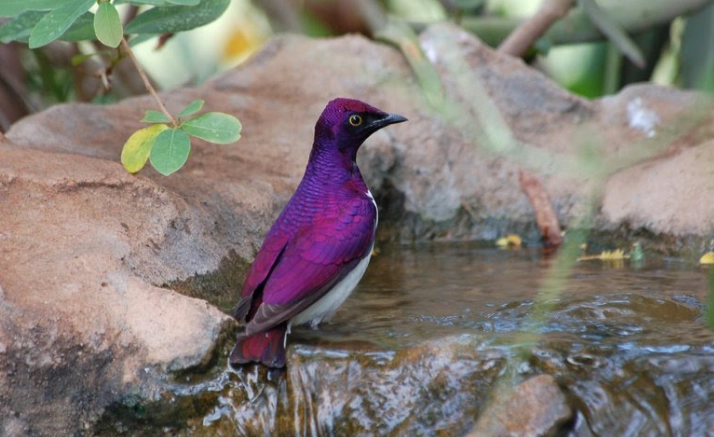
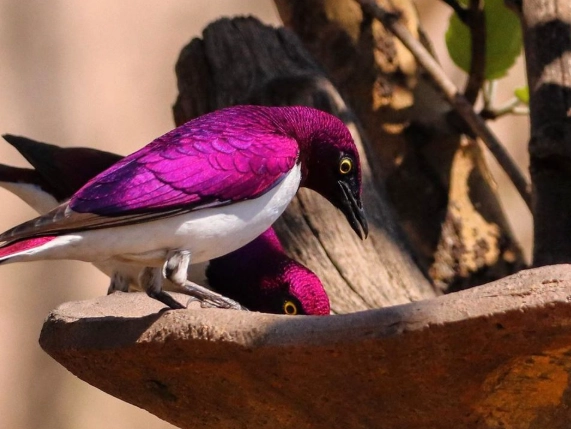
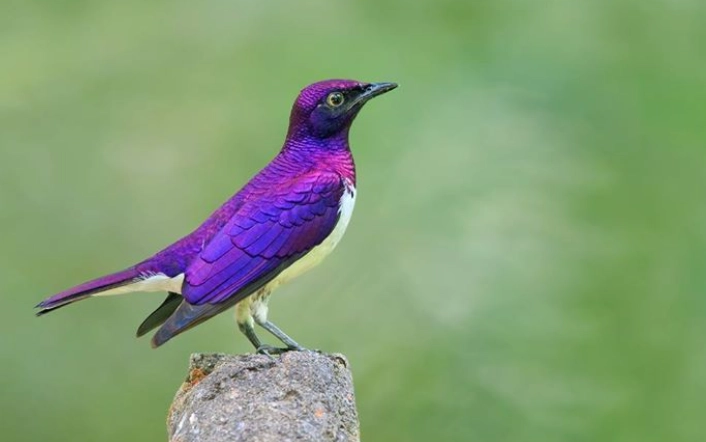
Let's be honest, you're here because you've seen a picture. A flash of impossible, metallic purple against the green African bush. The amethyst starling (Cinnyricinclus leucogaster) isn't just another bird; it's a moment of pure magic for any birder or nature lover. I've spent years chasing birds across East Africa, and the first time I saw one in full sun, I just stood there. It doesn't look real. This guide isn't a dry encyclopedia entry. It's everything I wish I knew before my first trip: where to go, how to find them, and how to avoid the common mistakes that leave people with blurry photos or no sighting at all. Forget the dull brown starlings you might know from Europe or North America. This is a different league. The adult male in breeding plumage is the showstopper. His entire head, neck, chest, and back are covered in short, dense feathers that refract light like a jewel. The color isn't a flat purple. It's an iridescent violet-amethyst that shifts to brilliant green or blue in the right light. Underneath, he's pure, clean white—a stunning contrast. The female is often overlooked, which is a mistake. She's beautiful in her own right: heavily streaked brown and white, resembling a large, elegant thrush. Juveniles look like a washed-out version of the female. This bird isn't evenly spread across Africa. It's a creature of specific woodlands and savannas, primarily in East Africa. You need a strategy. Based on my own logbooks and conversations with local guides, here’s where your odds are highest. I remember a specific evening in the Maasai Mara. We'd spent all day on lions and were heading back. Our guide, Samuel, suddenly stopped the vehicle. "Look, in that bare tree." And there it was—a male, preening, turning his head and flashing green, then purple. It was five minutes from camp. The lesson? The best sightings often come when you're not desperately looking for them. Knowing how it lives tells you where to look. They are frugivores. Fruit is their main gig. They love figs, berries, and other small fruits. This is your biggest clue. Find a fruiting tree, especially a wild fig (Ficus species), and wait. They'll often mix with other fruit-eating birds like hornbills or green pigeons. But they're not strict vegetarians. During the breeding season, they'll hawk insects from a perch or pick them off leaves, providing crucial protein for their chicks. They're social, but not in massive flocks like some starlings. You'll usually see them in small family groups or pairs. Their flight is direct and fast, with rapid wingbeats. This is where most people get frustrated. The color is a technical nightmare if you get it wrong. 1. Light is Everything: The iridescence only works with directional light. Early morning or late afternoon sun is ideal. Overcast days? The color turns into a dull, dark purple-blue. Midday sun can create harsh shadows. Aim for the sun behind you, shining directly on the bird. 2. Camera Settings: You need speed. These birds move quickly. 3. The Biggest Mistake I See: People spot the bird, get excited, and start blasting shots from where they stand. The background is a chaotic tangle of branches. Take three seconds. Move a few feet left or right. Try to get a cleaner background—sky, a distant blur of green, anything simpler. It makes the bird pop. Good news. According to the IUCN Red List, the amethyst starling is classified as Least Concern. Its population appears stable across its wide range. It adapts reasonably well to wooded farmland and gardens, as long as there are fruit trees. However, like all wildlife, it faces pressure from habitat loss and degradation. Supporting conservation areas and ethical tourism directly helps protect its home. You can check the latest assessment on the IUCN Red List website (search for Cinnyricinclus leucogaster). 1. They're messy nesters. Their nest is a loose, untidy cup of twigs and roots placed in a tree hole or sometimes even in a building eaves. Not exactly architectural geniuses. 2. The "glossy" name game. You might see it called the "purple glossy starling" or "plum-colored starling." It's all the same bird. Scientific names avoid this confusion. 3. They have a sweet tooth. There are reports of them being attracted to sugar-rich flowers for nectar, showing how flexible their fruit-based diet really is.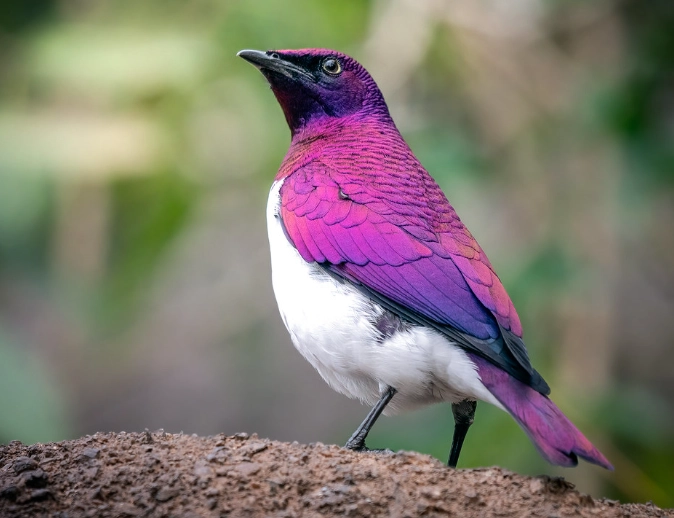
Your Quick Guide to the Amethyst Starling
What Does the Amethyst Starling Look Like?
Where Can You See Amethyst Starlings? (The Best Locations)
A Detailed Location Comparison Table
Location / Country
Best Time to Visit
Habitat Type
Birding Tips & Notes
Maasai Mara NR & Serengeti NP (Kenya/Tanzania)
Year-round (Dry seasons: Jun-Oct & Dec-Mar for easier access)
Acacia woodland, riverine forest edges.
Often seen near fig trees. Don't just look for big game; scan the trees around your lodge or picnic site.
Amboseli NP (Kenya)
Year-round
Acacia woodland with groundwater forests.
Surprisingly reliable around the swamps and palm thickets. Less crowded than Mara, sometimes better for patient birding.
Lake Nakuru & Lake Naivasha (Kenya)
Year-round
Wooded shores, acacia forests.
Great combo destination for flamingos AND the starling. The forest around Lake Naivasha's Crescent Island can be productive.
Ngorongoro Conservation Area (Tanzania)
Dry seasons (Jun-Oct)
Forest edges on the crater rim.
Often spotted in fruiting trees along the road down into the crater. A guide with a sharp eye is key here.
Queen Elizabeth NP (Uganda)
Dry seasons (Jan-Feb, Jun-Jul)
Mweya Peninsula, Ishasha woodland.
The northern limit of their range. Less common than in Kenya, but a thrilling find for a Uganda bird list.
Behavior, Diet, and Calls: Understanding the Bird
How to Photograph the Amethyst Starling: Pro Tips
Is the Amethyst Starling Endangered?
Beyond the Color: 3 Lesser-Known Facts
Your Questions, Answered (By a Guide Who's Been There)
Quick ID Tip: Listen for the sound, too. Their most common call is a high-pitched, squeaky "tseee" or a series of chattering notes. If you hear that in an acacia tree, look up.
What's the single biggest mistake photographers make when trying to photograph amethyst starlings?
Shooting in flat light. They see the purple blob in the tree and start clicking. The resulting photos are dark and lack the jewel-like quality. If the light isn't right, sometimes it's better to just enjoy the sighting through your binoculars and wait for the bird to move into a sunbeam. Patience yields the prize.
I'm planning a Kenya safari mainly for the big cats. Can I still see an amethyst starling without dedicated birding time?
Absolutely. In fact, the Mara or Amboseli are perfect for this. The key is to mention it to your driver-guide at the start of the day. Say, "I'd really love to see an amethyst starling if we come across one." A good guide will then keep an eye on fruiting trees and likely perches while you search for lions. The lodges themselves, especially those with mature gardens, are also hotspots. Have your camera ready at breakfast.
How does the amethyst starling's behavior change during the rainy season?
It becomes trickier. The foliage is denser, making the birds harder to spot. They're also more dispersed because food (fruit and insects) is abundant everywhere, not just in specific trees. However, this is their main breeding season. You might be lucky enough to see a pair carrying nesting material or feeding noisy chicks. The trade-off is visibility for potential intimate behavioral observations.
Are there any similar-looking birds I might confuse it with?
In East Africa, not really. The male's coloration is unique. The female could be confused with a female red-winged starling or a thrush, but her streaking is finer and more uniform. The white belly on the male is a dead giveaway. If you see a shiny purple bird with a white belly, you've got it.
Comment