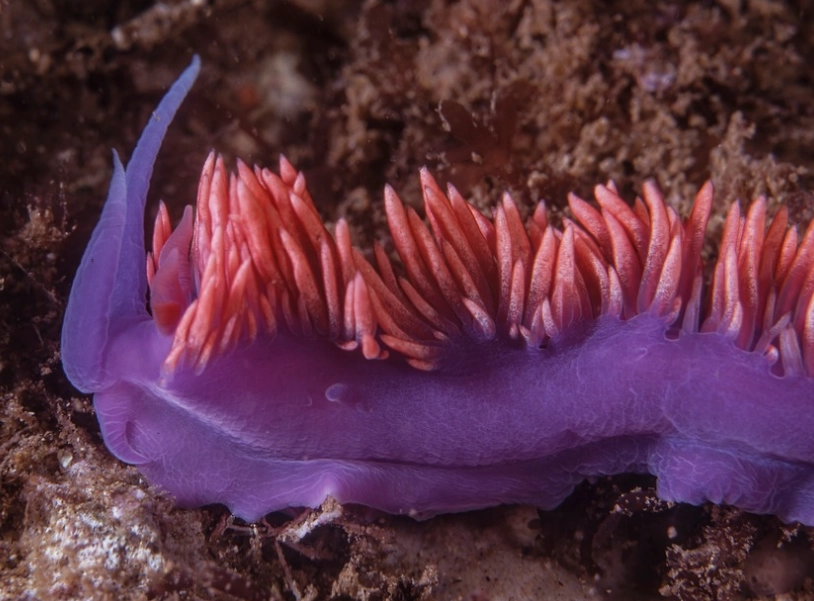
If you've ever been diving off the coast of California and seen what looks like a floating violet flame with orange sparks, you've met the Spanish Shawl. Scientifically named Flabellina iodinea, this nudibranch isn't just another pretty sea slug. It's a lesson in survival, color, and marine ecology wrapped into one unforgettable package. I remember my first encounter. It was a night dive in Monterey Bay, my light catching a flash of impossible purple against a dark wall. For ten minutes, I just floated there, watching it glide. Most dive guides will point it out and move on. But there's so much more to this creature than a quick photo op. This isn't a creature you'll find just anywhere. Its range is specific to the cool, nutrient-rich waters of the Eastern Pacific Ocean. A specific spot? The underwater walls of Monterey's Breakwater are famously reliable. But Catalina Island's reefs are a close second. The key is structure and current. Local Tip: New divers often scour the tops of reefs. Spanish Shawls frequently hang out on the vertical faces and undersides of ledges. Train your eyes to look on walls and overhangs, not just the seafloor. Let's break down that iconic look. The body is a vivid, almost neon purple. Those frilly, orange bits covering its back are called cerata (singular: ceras). This isn't just for show. The striking purple and orange is a classic example of aposematic coloration—nature's "danger" sign. But here's the twist: the Spanish Shawl doesn't produce its own toxins. It feeds primarily on hydroids, like Eudendrium ramosum. Hydroids are related to jellyfish and have stinging cells called nematocysts. The nudibranch eats them, then does something incredible. It transports the undischarged stinging cells through its digestive system and stores them in the tips of its cerata. Those orange frills become loaded weapons, deterring fish from taking a bite. The cerata also serve a vital respiratory function. They are filled with branches of the digestive gland and have a large surface area, allowing oxygen to diffuse directly from the water. The movement of the cerata helps circulate water over them. Finding one is a thrill. Getting a good shot or observation without stressing the animal is the real skill. Do not touch. I can't stress this enough. Beyond potentially harming their delicate skin and slime coat, you risk triggering the release of those stored nematocysts onto your fingers. It's not a severe sting for humans, but it's an irritant they don't need to waste. Approach slowly. Use minimal fin movement to avoid kicking up silt. They have simple eyespots and can detect shadows and movement. A sudden shadow from above might make them retract their cerata or change direction. This is where most beginners, and even some experienced shooters, get it wrong. The most common mistake I see is photographers blasting it with light, getting one over-exposed shot, and moving on. Spend five minutes. Watch its behavior. You might see it laying an egg ribbon, which makes for a phenomenal photo. Spanish Shawls are hermaphrodites, meaning each individual has both male and female reproductive organs. When two meet, they can mutually fertilize each other. The resulting egg mass is a beautiful, spiraling ribbon of pink or orange, often laid directly on the hydroids the adults feed on. This ensures the hatching larvae have an immediate food source. The larvae are planktonic, spending time drifting in the currents before settling down and metamorphosing into the tiny, crawling nudibranchs we recognize. This pelagic phase is why they can pop up in new locations.What's Inside This Guide
Where to Find the Spanish Shawl Nudibranch
The Biology Behind the Beauty
Color as a Warning
Breathing Through Their Skin
A Diver's Field Guide: Observation & Photography
Observation Etiquette
Underwater Photography Tips
Life Cycle & Reproduction
Your Spanish Shawl Questions Answered
What's the best time of day to see Spanish Shawl nudibranchs?
They're most active and visible at night or during twilight dives. Their colors are even more dramatic under a dive light. During the day, they often tuck themselves into crevices or under ledges, making them harder to spot. If you're on a day dive, focus your search on shaded, rocky overhangs.
Are Spanish Shawl nudibranchs poisonous or dangerous to touch?
Not directly. They don't produce their own toxins. The potential for irritation comes from the stinging cells (nematocysts) in the hydroids they eat, which they store in their cerata. Touching them can transfer those cells to your skin. More importantly, the slime coating on their skin is a critical defense against bacteria and fungi. Our touch can damage this coating, leaving them vulnerable to infection. The rule is simple: observe, don't touch.
How big do Spanish Shawl nudibranchs get?
They are typically between 2.5 and 7 centimeters (1 to 2.8 inches) in length. Their size, combined with their vivid color, makes them one of the easier nudibranchs to identify.
Can I find Spanish Shawl nudibranchs outside of the Pacific?
Almost certainly not in the wild. Their documented range is strictly the Eastern Pacific. However, their striking appearance makes them a popular exhibit in large public aquariums worldwide. So you might see one in captivity far from its home waters.
Comment